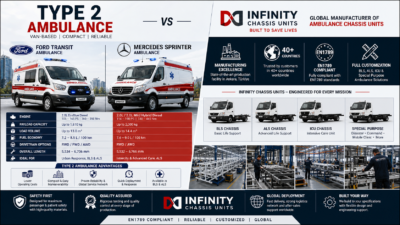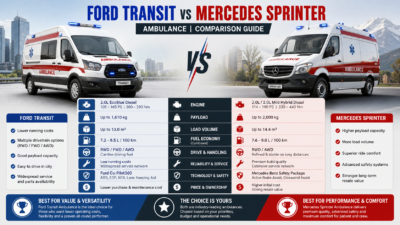
While the Type 2 van is the king of urban agility, the Ford Transit Box Type Ambulance (often referred to as a Type 1 or Type 3 modular unit) is the undisputed leader for critical care and long-distance transport. By mounting a wide, square medical “box” onto a Ford Transit 350 L or 470 L chassis, healthcare providers gain a massive increase in interior working space and payload capacity.
At ICU Automotive, we specialize in engineering high-performance modular conversions on the 2025-2026 Ford-Otosan chassis. Here is why the “Box Type” is the gold standard for Advanced Life Support (ALS).
1. The Anatomy of a Box Type Ambulance
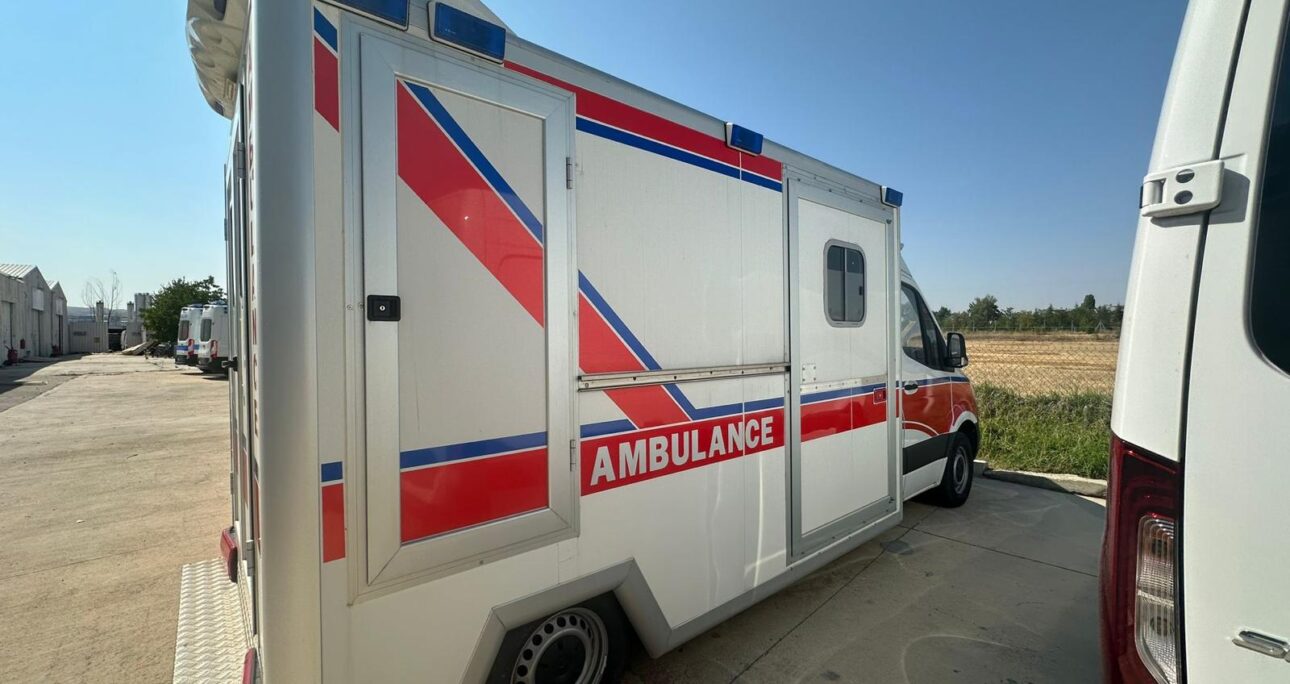
Unlike a standard van, the Ford Transit Box Type features a separate medical compartment built from high-strength sandwich panels.
- Square Interior: Vertical walls allow for massive storage cabinets and a 360-degree workspace around the patient.
- External Compartments: The exterior of the box features lockers for oxygen tanks, extrication tools, and battery systems, keeping the interior clutter-free.
- Wider Aisle: The extra width (up to 2.2 meters) allows two paramedics to work on the patient simultaneously—essential for cardiac or trauma cases.
2. 2026 Chassis Specs: Ford-Otosan Reliability
Our box conversions are built on the latest 2026 Zero KM Ford Transit chassis, specifically the heavy-duty variants:
- Engine: 2.0L EcoBlue Diesel (165 HP – 170 HP) or the 3.5L EcoBoost V6.
- Transmission: Heavy-duty 6-speed manual or 10-speed automatic.
- Chassis: 350 L (Long) or 470 (Heavy Duty) for maximum stability.
- Suspension: Reinforced rear leaf springs and stabilizers to handle the weight of the modular body and heavy ICU equipment.
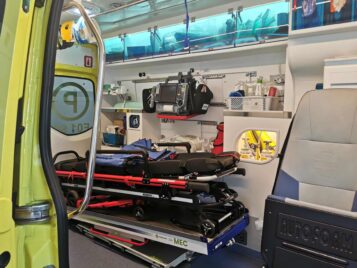
3. Interior Configuration: A Mobile Intensive Care Unit (ICU)
The Ford Transit box type ambulance interior is designed for the highest level of clinical care. Because we are a specialized manufacturer, we customize every unit to EN 1789 standards:
- Intensive Care Equipment: Enough space and power for 2-3 ventilators, multiple infusion pumps, and advanced multiparameter monitors.
- Isolation Capability: The separate box design allows for superior climate control and negative pressure systems—critical for infectious disease transport.
- Power Supply: Pure sine wave inverters (up to 3000W) to ensure sensitive diagnostic tools have “clean” electricity.
4. Why Choose the Box Design Over a Standard Van?
| Feature | Ford Transit Type 2 (Van) | Ford Transit Box Type (Modular) |
| Interior Space | Compact & Agile | Maximum Working Area |
| Payload | Standard | High (Heavy Equipment Ready) |
| Safety | Integrated Steel Body | Reinforced Aluminum/Composite Box |
| Best For | Urban Response / BLS | ICU / ALS / Rural Trauma |
5. Pricing and Availability for 2026
The Ford Transit Box Type ambulance price is higher than a standard van due to the specialized manufacturing of the modular body.
- New 2026 Units: Turnkey solutions starting from $95,000 – $130,000 USD, depending on medical equipment specs (Ventilators, Defibrillators, Power-load stretchers).
- Export Ready: We provide all documentation (EUR.1, Certificate of Conformity) for global shipping from Turkey.
Partner with ICU Automotive
As a leading Ford Transit ambulance manufacturer, we combine the reliability of the Ford-Otosan chassis with world-class modular engineering. Whether you need a high-roof van or a wide-body box type, our team ensures your vehicle is built to save lives.
[Request a Quote for Box Type Models] | [View Our 2026 Catalog]