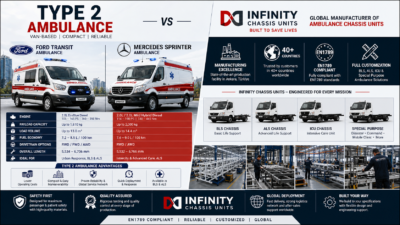
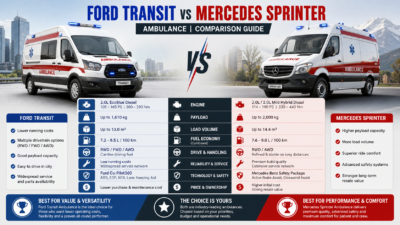
When it comes to selecting a chassis for a Type 2 ambulance and Compare Ford Transit vs. Mercedes Sprinter, two giants dominate the conversation: the Ford Transit and the Mercedes-Benz Sprinter. Both are world-class platforms, but they cater to different operational needs, budgets, and maintenance environments.
At ICU Automotive, we convert both. However, choosing the right one for your fleet requires a deep dive into performance, cost of ownership, and “upfit” potential. Here is the ultimate 2026 comparison.
1. Reliability and Performance Ford Transit vs. Mercedes Sprinter
Both vehicles offer modern turbo-diesel and gasoline engines, but their “feel” on the road differs:
- Ford Transit: Known for its punchy 3.5L EcoBoost® V6. It offers incredible acceleration, which is vital for emergency response. The 10-speed automatic transmission is smooth and widely serviceable.
- Mercedes Sprinter: Famous for its 2.0L 4-cylinder diesel torque. It’s a marathon runner—built for long-distance patient transport with exceptional fuel efficiency.
2. Maintenance and Total Cost of Ownership (TCO) Ford Transit vs. Mercedes Sprinter
This is where the Ford Transit ambulance often takes the lead in global markets (especially in the Americas and Middle East):
- Parts Availability: Ford parts are generally more affordable and easier to find in remote regions. Any standard Ford commercial dealer can service a Transit.
- Specialized Service: The Sprinter often requires specialized Mercedes-Benz diagnostic tools and BlueTEC® (AdBlue) system maintenance, which can be more expensive over a 5-year cycle.
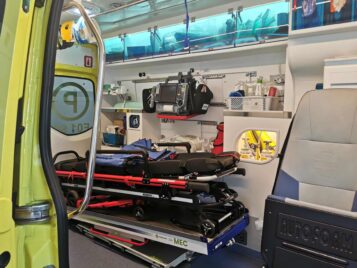
3. Interior Space and Conversion Potential
For a Type 2 ambulance interior, every millimeter counts.
| Feature | Ford Transit (High Roof) | Mercedes Sprinter (High Roof) |
| Max Standing Height | Approx. 201 cm | Approx. 200 cm |
| Interior Width | Slightly wider at the beltline | Narrower, more “squared” walls |
| Payload Capacity | High (Up to 2,000+ kg) | Exceptional (Heavy-duty rear axles) |
The Verdict: The Ford Transit’s slightly wider interior makes it easier to fit side-mounted medical cabinets while leaving a clear path for the stretcher. The Sprinter’s vertical walls are better for mounting uniform, modular shelving.
4. Drive Systems: AWD vs. 4WD
If your ambulance operates in snow, mud, or hilly terrain:
- Ford Transit Intelligent AWD: This system is “always on” and shifts power automatically. It’s user-friendly for paramedics who aren’t off-road experts.
- Mercedes Sprinter 4×4/AWD: Historically more robust for “true” off-road conditions, though the newer Sprinter AWD systems are now more electronic and similar to Ford’s.
5. Pricing: The Bottom Line
As seen in our 2026 Ford Transit ambulance price guide, the Transit typically holds a price advantage:
- Ford Transit: Generally 15-20% more affordable to purchase and upfit than a Sprinter.
- Mercedes Sprinter: A premium investment. You pay for the “Three-Pointed Star” prestige and slightly higher resale value in European markets.
Which One Should You Choose?
Choose the Ford Transit Ambulance if:
- You need a faster, more agile vehicle for urban response.
- Lower maintenance costs and parts availability are priorities.
- You want the best “value for money” in a Type 2 ambulance.
Choose the Mercedes Sprinter Ambulance if:
- Brand image and prestige are vital for your private clinic.
- You prioritize long-distance fuel economy over raw acceleration.
- You have easy access to authorized Mercedes-Benz service centers.
Get a Comparison Quote from ICU Automotive
At ICU Automotive, we provide equipped Ford EMS vehicles and Sprinter conversions tailored to your specific medical protocol. Whether it’s a Ford Transit Custom ambulance for city agility or a Sprinter for luxury transport, we build it to EN 1789 standards.
[Compare Technical Specs] | [Request a Quote for Both Models]