In the high-stakes world of emergency medical services, one size rarely fits all. Every EMS organization operates in a unique environment with distinct patient populations, response challenges, and clinical protocols. This reality has driven the growing demand for Custom Ford Transit Ambulance solutions—vehicles designed not just to transport patients, but to function as extensions of your specific medical capabilities.
The Ford Transit has emerged as the platform of choice for custom design ambulance projects worldwide . Its versatile chassis, efficient powertrain, and adaptable interior space make it an ideal foundation for creating equipped Ford EMS vehicles that meet the exact needs of your service. Whether you’re responding to 911 calls in dense urban centers, navigating rural terrain, or providing specialized critical care transport, a custom Ford Transit ambulance can be configured to support your mission.
This comprehensive guide explores the world of customized Ford Transit ambulances, from interior layout options to medical equipment integration, helping you understand how to build a vehicle that truly serves your paramedics and patients.
What Is a Custom Ambulance and Why Choose Customization?
A custom ambulance begins with a standard chassis—in this case, the Ford Transit—and transforms it through specialized upfitting into a purpose-built emergency medical vehicle. Unlike off-the-shelf solutions, custom builds allow you to specify every aspect of the vehicle’s design, from cabinetry layouts to electrical system capacity.
The Case for Customization
Every EMS agency faces unique operational demands. A service covering mountainous terrain needs different capabilities than one operating in congested city streets. A hospital-based critical care transport team requires different equipment than a volunteer BLS service. Customization bridges the gap between a generic vehicle and one that truly supports your clinical workflows.
The Ford Transit Advantage
The Ford Transit platform is particularly well-suited for custom ambulance projects due to several key attributes :
- Modular Design: The Transit’s open interior architecture provides exceptional flexibility for custom layouts
- Ambulance Preparation Package: Ford offers a factory-installed package specifically designed to support converters, including dual AGM batteries, dual alternators, auxiliary fuse panels, and modified wiring systems
- Multiple Roof Configurations: Available in medium and high-roof variants, the Transit accommodates different headroom requirements
- All-Wheel Drive Availability: For services operating in challenging weather or terrain, AWD provides enhanced traction
Understanding Ambulance Types and Customization Levels
Before diving into specific equipment packages, it’s essential to understand the different ambulance configurations available on the Ford Transit platform.
Type II Van Ambulance
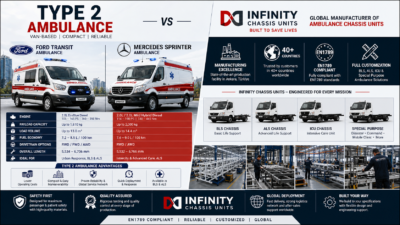
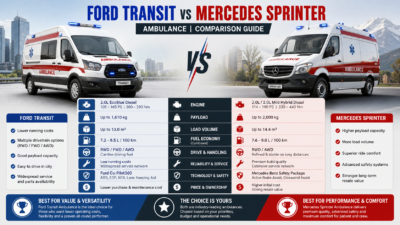
The Type II configuration maintains the Transit’s van body with a raised roof, creating an integrated patient compartment. This is the most common platform for custom design ambulance projects due to its balance of maneuverability and interior space.
Typical Dimensions:
- Exterior Length: Approximately 5,680mm
- Exterior Width: Approximately 1,974mm
- Exterior Height: Approximately 2,787mm
- Interior Length: Approximately 3,200mm
- Interior Width: Approximately 1,700mm
- Interior Height: 1,710mm to 1,925mm
Box-Type (Modular) Ambulance
For services requiring maximum interior space and storage, the box-type configuration mounts a custom modular body on a cutaway Transit chassis. This design offers greater payload capacity and can accommodate specialized equipment for critical care transport.
Interior Layout Options for Custom Ford Transit Ambulances
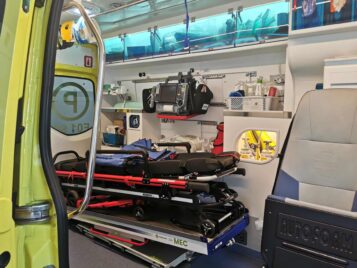
The heart of any custom ambulance is its interior configuration. How you arrange the patient compartment directly impacts clinical care, crew efficiency, and safety.
Basic Life Support (BLS) Configuration
Designed for non-critical patient transport, BLS configurations focus on essential care during interfacility transfers. These layouts typically include :
- Spacious interior for a full-size stretcher
- Seating for 2-3 medical attendants
- Basic medical equipment mounting points
- Oxygen supply systems
- AED mounting locations
- ADA-compliant access features
Best for: Routine patient transfers, dialysis transport, clinic visits, and non-urgent medical evacuations
Advanced Life Support (ALS) Configuration
ALS ambulances function as mobile intensive care units, equipped for emergency response and critical interventions. These equipped Ford EMS vehicles feature :
- Advanced cardiac monitoring systems (ECG, defibrillators)
- Portable ventilator mounting and storage
- IV infusion pump integration
- Emergency medication storage
- Enhanced onboard power systems
- Telemetry and communication equipment
Best for: Emergency 911 responses, cardiac arrests, trauma cases, and critical care transports
Pediatric and Neonatal Configuration
Specialized configurations for young patients require age-appropriate equipment and thoughtful interior design :
- Infant incubator mounting systems
- Pediatric stretchers with appropriate restraints
- Child-sized medical devices
- Specialized medication dosing tools
- Calming interior elements
Best for: Neonatal ICU transfers, pediatric specialty care transport
Stork Ambulance (Mobile Maternity Unit)
For services responding to obstetric emergencies, specialized configurations include :
- Onboard delivery kits with sterile instruments
- Birthing bed or appropriate patient positioning
- Fetal and maternal monitoring systems
- Emergency obstetric medications
- Neonatal resuscitation equipment
Best for: Rural maternity transport, emergency childbirth scenarios
Essential Equipment Packages for Ford Transit Ambulances
The equipment you specify transforms a basic vehicle into a fully functional custom ambulance. Understanding the available options helps you make informed decisions.
Stretcher and Patient Handling Systems
Patient loading and securement systems form the foundation of any ambulance. Options include :
- Main Stretcher Systems: Electric or manual stretchers with appropriate weight capacity
- Stretcher Locking Systems: Secure mounting mechanisms that meet crash safety standards
- Movable Stretcher Platforms: Adjustable positioning for patient care access
- Loading Ramps: For safe and ergonomic patient loading
- Combination Stretchers: Versatile options for various patient scenarios
- Vacuum Stretchers and Pumps: For patient immobilization
Oxygen and Medical Gas Systems
Reliable oxygen delivery is non-negotiable in emergency care. Typical configurations include :
- Dual 10-liter oxygen cylinders
- Oxygen tubing and regulators
- Flowmeters for precise delivery control
- Oxygen pipeline systems with pressure monitoring
- Vacuum systems with pumps and collection jars
- Oxygen alarms that alert attendants to flow interruptions
Medical Devices and Monitoring Equipment
ALS and critical care configurations require integration of advanced medical technology :
- Cardiac Monitoring: AED defibrillators, ECG monitors
- Respiratory Support: Transport ventilators suitable for infant, child, and adult patients, resuscitation units
- Diagnostic Tools: Glucometers, blood pressure monitors, stethoscopes, diagnostic sets, thermometers
- Airway Management: Inflatable splint sets, cervical collar sets, spine boards with head immobilizers
- Suction Equipment: Portable vacuum aspirators with mounting kits
Disposable Supplies Storage
Efficient storage for consumables ensures paramedics have what they need when they need it :
- Oxygen masks (adult and child)
- Nasal cannulas
- Syringes in various sizes
- IV catheters and butterfly sets
- Aspiration catheters
- Foley catheters and urine bags
- IV fluid sets
Paramedic Trauma Kits
Every custom ambulance should include strategically located paramedic trauma kit storage. These kits contain essential equipment for immediate life-saving interventions and should be positioned for rapid access upon patient contact.
Interior Finishes and Materials
The materials used inside a custom design ambulance affect durability, infection control, and crew comfort.
Flooring and Wall Panels
Modern ambulance interiors utilize specialized materials designed for the emergency environment :
- Anti-bacterial Epoxy Flooring: Non-porous surfaces that resist contamination and are easy to clean
- Aluminum Interior Panels: Lightweight yet durable, with sound and heat insulation
- Non-flammable Materials: Fire-resistant properties meeting safety standards (UL 94 V-0 rating)
- Non-slip Surfaces: Critical for crew safety during transport
Cabinetry and Storage Solutions
Custom cabinetry maximizes available space while keeping equipment organized and accessible :
- Aluminum Construction: Laser-cut, precision-bent aluminum components provide durability without excess weight
- Modular Cabinet Systems: Adjustable configurations that can be tailored to specific equipment needs
- Quick-Release Brackets: Wall-mounted track systems for rapid equipment access
- Intravenous Strips: Overhead mounting points for IV bags
- Upper Handlebars: Support for crew moving through the patient compartment
Seating Configurations
Crew seating must balance comfort with crash safety :
- Squad Benches: Seating for multiple attendants along the patient compartment wall
- Swivel Seats: Allowing attendants to face the patient during care
- Collapsible Seats: Space-saving options for flexible layouts
- Military-Grade Materials: For extreme durability in demanding environments
Advanced Technology Integration
Modern equipped Ford EMS vehicles incorporate sophisticated technology that enhances both clinical care and fleet management.
Electrical and Power Systems
Reliable power is essential for medical devices and vehicle operations :
- Dual AGM Batteries: Extended capacity for auxiliary systems
- Dual Alternators: Increased charging capability for high electrical loads
- Auxiliary Fuse Panels: Organized power distribution for aftermarket equipment
- Inverters: 12V to 220V conversion (typically 1000W or higher)
- Gel Batteries: Backup power for extended scene operations
Multiplex Control Systems
Advanced electrical management systems give crews intuitive control over vehicle functions. Demers ambulances feature MMC (Multiplex Modular Connected) systems with touchscreen controls for lighting, climate, and auxiliary systems .
Telematics and Communication
Modern ambulances are connected vehicles :
- Vehicle Informatics Modules: Combine GPS data with vehicle diagnostics
- Multiple Touchscreens: Typically one in the cab and two in the patient compartment
- Cloud-Based Monitoring: Allowing fleet managers to track vehicle status
- Two-Way Mobile Radios: Integrated communication systems
Lighting Systems
Emergency lighting must balance visibility with patient comfort :
- LED Warning Lights: High-visibility directional light heads (front grille, rear door panels)
- Scene Lighting: Side-mounted lights for illuminating work areas
- Patient Compartment Lighting: Blue LED options create a calming environment
- Digital Control: Touchscreen-operated lighting scenes for different situations
Specialized Customizations for Unique Environments
Off-Road and Military Configurations
For services operating in challenging terrain, specialized modifications enhance capability :
- Raised Suspension: Increased ground clearance for rugged terrain
- Heavy-Duty Front Bumpers: With tow hooks and winch mounting points
- All-Terrain Tires: Improved traction off-road
- Military-Grade Components: Reinforced for extreme durability
- Aluminum Cargo Floors: Withstanding heavy interior loads
- External Equipment Mounts: Jerry can and spare wheel brackets, high-lift jacks
Urban Response Configurations
For congested city environments, maneuverability takes priority :
- Compact Footprint: Standard wheelbase for tight turns
- Excellent Visibility: Driver sightlines enhanced for navigating narrow streets
- Sliding Side Doors: Wide access even in tight parking situations
- Rear Barn Doors: Efficient patient loading in confined spaces
Rural and Remote Configurations
Services covering vast geographic areas need extended capabilities :
- Extended Range: Additional fuel capacity or fuel-carrying options
- Enhanced Payload: Carrying more equipment for longer response times
- Durable Suspension: Tuned for rough road conditions
- High Ground Clearance: Navigating unimproved roads
The Customization Process: From Concept to Completion
Creating a custom ambulance involves several key steps:
1. Needs Assessment
Begin by thoroughly evaluating your operational requirements:
- What types of calls do you typically respond to?
- What equipment must you carry?
- How many crew members ride in the patient compartment?
- What are your response area’s geographic challenges?
- What regulations must your vehicle meet (KKK-A-1822F in the U.S., CEN 1789 in Europe) ?
2. Working with Certified Upfitters
Partner with experienced ambulance manufacturers who specialize in Ford Transit conversions. Companies like Braun Ambulances offer “Built for Life” craftsmanship with lifetime structural warranties .
3. Design and Layout
Collaborate with the upfitter to create interior layouts that support your clinical workflows. Modern computer-aided design allows you to visualize the finished vehicle before construction begins.
4. Equipment Selection
Specify the medical equipment that will be integrated into the vehicle. This includes not only the devices themselves but also mounting systems, power connections, and storage locations.
5. Compliance and Certification
Ensure the finished vehicle meets all applicable safety and performance standards. Proper certification is essential for insurance coverage and emergency service contracts .
Benefits of Customized Ford Transit Ambulances
For Patients
- Smoother Rides: The Transit’s independent suspension reduces motion-induced discomfort
- Appropriate Care Environment: Equipment and space designed for specific patient populations
- Climate Control: Dedicated patient compartment HVAC for optimal comfort
For Medics
- Ergonomic Workspace: Layouts designed for efficient patient care
- Reduced Injury Risk: Lower loading heights and well-designed patient handling systems
- Organized Equipment: Everything has its place, reducing stress during calls
For Administrators
- Fleet Standardization: Custom vehicles that meet your specific protocols
- Extended Service Life: Quality upfits with remount programs extend vehicle longevity
- Brand Identity: Custom graphics and color schemes that reflect your organization
- Lower Operating Costs: Fuel-efficient Transit platform reduces expenses
Frequently Asked Questions (FAQs)
1. What is the difference between a custom ambulance and a standard factory ambulance?
A custom ambulance is built to your specific requirements rather than purchased as a pre-configured inventory unit. While a standard ambulance offers fixed layouts and equipment packages, a custom design ambulance allows you to specify every aspect of the interior configuration, from cabinetry placement to electrical system capacity. This ensures the vehicle supports your specific clinical protocols and operational environment .
2. What equipment is typically included in a paramedic trauma kit for a Ford Transit ambulance?
A comprehensive paramedic trauma kit for a Ford Transit ambulance typically includes airway management devices (cervical collars, spine boards, intubation supplies), hemorrhage control equipment (tourniquets, hemostatic dressings), diagnostic tools (blood pressure monitors, stethoscopes, glucometers), and emergency medications. The kit is typically stored in a strategically located cabinet or quick-release bracket for immediate access upon patient contact .
3. Can I customize a Ford Transit ambulance for both ALS and BLS services?
Yes, the Ford Transit platform is highly adaptable for mixed-use scenarios. Many services choose modular interior designs that accommodate both BLS and ALS equipment through configurable storage systems. You might specify removable ALS equipment modules that can be added or removed as needed, or design a layout that permanently accommodates both levels of care. Working with an experienced upfitter helps you achieve the right balance .
4. What are the key considerations when designing the interior layout of a Ford Transit ambulance?
Key considerations include: patient access (ensuring 360-degree access to the stretcher), crew workflow (positioning frequently used equipment within easy reach), safety compliance (meeting crash test standards for all mounted components), storage capacity (adequate space for your specific equipment inventory), and infection control (using non-porous, easy-to-clean materials). Also consider future needs—a flexible layout can adapt as your service evolves .
5. How does the Ford Transit Ambulance Preparation Package support customization?
The Ford Ambulance Preparation Package (47B) is a factory-installed option that includes features specifically designed to support converters: dual AGM batteries for extended auxiliary power, dual alternators for increased charging capacity, an auxiliary fuse panel with high-spec interface connector, modified wiring systems to simplify upfitting, and privacy glass. This package ensures a reliable foundation for equipped Ford EMS vehicles .
6. What safety standards should a custom Ford Transit ambulance meet?
In North America, ambulances typically must meet the KKK-A-1822F federal specification or the more recent GSA KKK standards. In Europe, compliance with CEN 1789 is required, which governs design, equipment, and crew safety. Additionally, all seating and occupant restraints must meet applicable crash safety standards (SAE/NHTSA in the U.S.). Always verify that your upfitter builds to the standards applicable in your region .
7. Can I add all-wheel drive to my custom Ford Transit ambulance?
Yes, Ford offers the Transit with available all-wheel drive (AWD) on many configurations. This is highly recommended for services operating in areas with snow, ice, or challenging terrain. The AWD system continuously monitors traction and distributes power to the wheels with the most grip, enhancing stability during emergency response driving .
8. How long does it take to build a custom Ford Transit ambulance?
Lead times vary significantly depending on the upfitter, complexity of the build, and current demand. Typical timelines range from six to twelve months from order to delivery. Factors affecting timeline include chassis availability, complexity of customizations, and the upfitter’s current workload. Planning ahead and communicating clearly with your manufacturer helps manage expectations.
9. What maintenance considerations are unique to custom ambulances?
Custom ambulances require attention to both the Ford chassis and the upfit components. The Ford Transit benefits from an extensive dealer network for routine chassis maintenance. The patient compartment requires regular inspection of electrical systems, cabinetry mounting, and medical equipment. Many upfitters offer service support and can provide documentation for all custom components. Establishing a preventive maintenance schedule is essential for reliability.
10. Can a used Ford Transit ambulance be customized or reconfigured?
Yes, used Ford Transit ambulances can often be reconfigured to meet new requirements. Many upfitters offer remount programs where a new chassis is combined with a reconditioned patient module, or existing modules can be modified with new cabinetry and equipment layouts. This can be a cost-effective way to update your fleet while extending the life of well-maintained modules.
Conclusion
The Ford Transit platform offers an exceptional foundation for creating custom ambulance solutions that truly serve your organization’s unique needs. From basic patient transport vehicles to advanced life support units equipped for critical care, the flexibility of the Transit chassis combined with expert upfitting creates equipped Ford EMS vehicles that enhance patient care and crew efficiency.
By understanding your operational requirements, working with experienced manufacturers, and thoughtfully selecting equipment packages, you can build a custom design ambulance that becomes not just a vehicle, but a true partner in emergency medical services.
Whether you’re responding to 911 calls in urban centers, navigating rural terrain, or providing specialized critical care transport, a custom Ford Transit ambulance puts the right tools in the right places—helping your paramedics save lives every day.