When it comes to emergency medical services, the vehicle you choose is more than just transportation—it’s a mobile emergency room, a workspace for highly trained professionals, and a lifeline for patients in crisis. Among the many options available today, Ford Transit ambulance models have emerged as industry leaders, offering versatility, reliability, and innovative design that adapt to virtually any emergency response scenario.
Understanding the differences between available ford ambulance models is essential for fleet managers, EMS directors, and healthcare administrators looking to make informed purchasing decisions. This comprehensive guide explores every Ford Transit ambulance configuration, compares their features, and helps you determine which model best serves your specific operational needs.
Why Ford Transit Has Revolutionized Emergency Response
Before diving into specific models, it’s worth understanding why the Ford Transit platform has become so prevalent in the EMS industry. The Transit represents a significant evolution from the boxy, truck-based ambulances of the past .
The chassis features a lower floor height that reduces crew injuries during patient loading—a critical consideration given that EMS professionals have one of the highest rates of workplace musculoskeletal injuries. The independent front suspension provides a smoother ride that benefits both patients with spinal injuries and sensitive medical equipment mounted inside the patient compartment .
Perhaps most importantly, the 3.5L EcoBoost V6 engine delivers impressive torque for rapid response while achieving substantially better fuel economy than the V10 and diesel options found in older ambulance platforms . For services operating on tight municipal budgets, these fuel savings accumulate significantly over a vehicle’s service life.
Understanding Ford Transit Ambulance Classifications
Ford ambulance models built on the Transit platform generally follow the North American ambulance classification system, though with some modern variations. Understanding these categories is the first step in choosing the right vehicle .
Type I Ford Transit Ambulance
The Type I configuration mounts a custom-built modular patient compartment onto a cutaway Ford Transit chassis. Unlike the integrated van body of other types, the Type I features a distinct separation between the cab and the patient module .
Key characteristics:
- Built on Transit cutaway chassis with cab separated from patient module
- Maximum exterior storage through modular compartment design
- Superior payload capacity for heavy rescue equipment
- Available with all-wheel drive for all-weather capability
Ideal use cases:
- Rural EMS agencies covering long distances
- Services requiring extensive equipment storage
- Fire departments needing integrated rescue capabilities
- High-volume 911 providers with diverse call types
The Type I configuration excels when you need to carry everything from extrication tools to advanced life support equipment. The modular design allows upfitters to create highly customized compartment layouts that keep gear organized and accessible .
Type II Ford Transit Ambulance
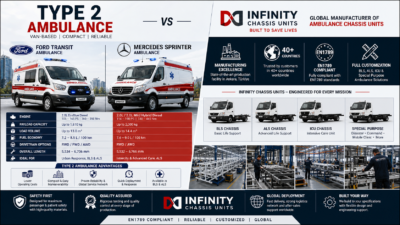
The type 2 ambulance configuration represents the most recognizable Ford Transit emergency vehicle. Built directly on the Transit van platform, it maintains the vehicle’s original silhouette while adding a raised roof and custom medical interior .
Manufacturers like Demers offer the TS model, a Type II ambulance designed specifically for services seeking a compact, maneuverable platform with lower total cost of ownership. Built on the Ford Transit chassis with available AWD, it delivers confident handling in tight streets, urban environments, and challenging weather conditions .
Key characteristics:
- Integrated van body with raised roof
- Lower step-in height for safer crew access
- Superior fuel economy compared to modular builds
- Excellent maneuverability in congested areas
- Interior headroom typically 68-69 inches
Ideal use cases:
- Urban and suburban 911 response
- Private patient transfer services
- ALS and BLS transport
- Services prioritizing maneuverability and efficiency
The Medix SRH-148WD exemplifies the modern Type II Ford Transit ambulance. Available on Transit 250 medium roof or Transit 350 high roof chassis, it features a compact footprint of 100.7 inches in height, 79 inches in width, and 68.5 inches of compartment headroom—dimensions that balance interior workspace with urban maneuverability .
Interior features typically include:
- Squad bench seating for multiple attendants
- CNC-produced cabinetry for organized storage
- Advanced Whelen emergency lighting systems
- Single-piece formed fiberglass ceilings for easy cleaning
- EVS safety seating meeting SAE/NHTSA standards
Type III Ford Transit Ambulance
The Type III configuration combines elements of both Type I and Type II designs. Like the Type I, it features a modular patient compartment, but it’s mounted on a cutaway van chassis that maintains a walk-through connection between the cab and the patient area .
The Transit High Roof model is commonly used for this configuration, providing exceptional interior space for medical staff and equipment .
Key characteristics:
- Walk-through access from cab to patient module
- Modular body on cutaway Transit chassis
- Maximum interior space for critical care equipment
- Full ALS capabilities with room for ventilators and monitors
- Superior patient access and caregiver mobility
Ideal use cases:
- Critical care transport services
- High-acuity 911 response
- Rural and suburban EMS operations
- Services requiring full walk-through access
The Type III represents the most popular design in North America for emergency response, offering the best balance of interior space and drivability for most applications .
Ford Transit Custom Ambulance
The ford transit custom ambulance represents a specialized variant built on the smaller Transit Custom platform. This configuration is designed for services that need emergency response capabilities in a more compact footprint .
Key characteristics:
- Smaller overall dimensions than full-size Transit
- Agile handling ideal for congested urban environments
- Lower purchase and operating costs
- Suitable for BLS and basic ALS response
Ideal use cases:
- Dense urban centers with narrow streets
- Event medical coverage
- Quick response vehicles
- Services with limited garage space
Specialty Medical Vehicles
Beyond the standard classifications, Ford Transit platforms serve as the foundation for highly specialized medical vehicles. These ford transit custom ambulance configurations address specific clinical needs that standard ambulances cannot accommodate .
Critical Care Transport Units:
Equipped with ICU-level technology including advanced ventilators, multiple infusion pumps, and extended oxygen supplies. These vehicles support the safe transport of unstable patients between facilities .
Neonatal Ambulances:
Specially configured with incubators, pediatric monitoring systems, and temperature-controlled environments. The smooth ride of the Transit chassis is particularly valuable for vulnerable neonatal patients .
Mobile Clinics:
Converted for on-site medical screenings, vaccinations, and community health outreach. These vehicles prioritize examination space and patient privacy over emergency response capabilities .
Bariatric Transport Units:
Featuring reinforced floors, wider door openings, and heavy-duty cot systems to accommodate bariatric patients safely and with dignity.
Detailed Technical Specifications Comparison
Understanding the technical specifications of different ford ambulance models helps match the vehicle to your operational requirements .
Ford Transit T350 (Type II) Specifications
The Ford Transit T350HD extended high roof configuration, used by manufacturers like Demers for their TXB model, offers these specifications :
| Specification | Detail |
|---|---|
| Drivetrain | All-wheel drive available |
| Engine | 3.5L EcoBoost V6 |
| Horsepower | 310 HP at 5,000 RPM |
| Torque | 400 lb-ft at 2,500 RPM |
| Transmission | 10-speed automatic |
| GVWR | 9,900 lbs (4,491 kg) |
| Maximum Payload | 2,160 lbs (980 kg) |
| Wheelbase | 148 inches (3,760 mm) |
| Total Length | 264 inches (6,706 mm) |
| Exterior Height | 114 inches (2,896 mm) |
| Interior Headroom | 81.5 inches (2,070 mm) |
| Loading Height | 29 inches (737 mm) |
Medix SRH-148WD Specifications
The Medix SRH-148WD Type II ambulance, built on the Ford Transit platform, offers these dimensions :
| Specification | Detail |
|---|---|
| Available Chassis | Transit 250 MR / Transit 350 HR |
| Wheelbase | 148 inches |
| Engine | 3.5L EcoBoost Gas (RWD or AWD) |
| Transmission | 10-speed Select Shift Automatic |
| Floor Length | 122+ inches |
| Overall Height | 100.7 inches |
| Overall Width | 79 inches |
| Aisle Width | 37 inches |
| Compartment Headroom | 68.5 inches |
| GVWR (250 MR) | 9,070 lbs |
Heavy-Duty Transit Variants
For services requiring maximum payload capacity, Ford offers a 5.0-tonne Transit variant with a 5,000kg gross vehicle mass and net payload up to 2,558kg. This heavy-duty configuration is ideal for box body ambulances and critical care transport units carrying extensive equipment .
Interior Layouts and Patient Compartment Configurations
The ambulance interior is where clinical care happens, and Ford Transit models offer remarkable flexibility in layout design .
Squad Bench Configuration
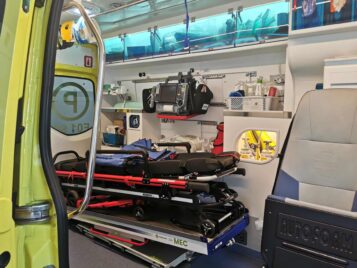
The most common interior layout features a squad bench mounted along the driver’s side wall. This configuration allows multiple attendants to sit securely while providing patient care. Demers TS models maximize this compact footprint with smart aluminum cabinetry and well-organized storage that keep essential equipment close at hand .
Typical squad bench features:
- Seating for 2-3 attendants
- Individual thermoformed backs for comfort
- Integrated seat belt systems (often EVS 4-point)
- Storage beneath bench for backboards and supplies
ALS and Critical Care Layouts
For advanced life support services, interior layouts prioritize monitor access and medication storage. These configurations typically feature :
- Dedicated ALS cabinet near the head of the stretcher
- Swivel seat allowing paramedic to face patient during transport
- CPR seat positioned at the head of the cot for airway management
- Multiple oxygen outlets (typically 2-3 in action area)
- Recessed IV holders in ceiling
- Integrated suction systems
Advanced Technology Integration
Modern Ford Transit ambulances feature sophisticated technology that enhances both clinical care and vehicle operations .
MMC Multiplex System:
Demers vehicles feature the MMC system, giving paramedics digital control of ambulance functions through a touchscreen with configurable settings tailored to local operational needs .
Electrical Diagnostics:
Bluetooth-enabled diagnostics simplify electrical troubleshooting with instant visibility into system status. This allows maintenance teams to identify issues quickly without specialized tools .
Climate Control:
Advanced HVAC systems maintain patient comfort regardless of external conditions. The Medix SRH-148WD features a combo 35K BTU heat and 32K BTU cool system with 630 CFM multi-speed fan and ducted air distribution .
Power Distribution:
Robust electrical systems include multiple 12V DC outlets, 120V AC hospital-grade outlets, USB charging ports, and pre-wiring for inverters and battery chargers .
Advantages of Ford Transit Ambulances for Emergency Services
The widespread adoption of Ford Transit ambulances across North America reflects genuine operational advantages that benefit patients, crews, and administrators alike .
For Patients
Smoother Ride Quality: The Transit’s independent front suspension and refined chassis absorb road imperfections better than traditional truck-based ambulances. This reduces the risk of aggravating spinal injuries or causing discomfort during transport .
Climate Control: Dedicated patient compartment HVAC maintains optimal temperatures regardless of external conditions, crucial for patients in shock or with temperature regulation issues .
Reduced Transport Times: The Transit’s responsive acceleration and agile handling help crews navigate traffic more effectively, potentially reducing transport times to definitive care .
For Medics
Ergonomic Access: The lower floor height reduces the physical strain of repeated patient loading, helping reduce workplace injuries—a critical concern in EMS .
Well-Organized Workspace: Smart cabinetry and thoughtful storage layouts keep equipment accessible without cluttering the care area. The Demers TS maximizes its compact footprint with organized storage that supports efficient workflows .
Enhanced Safety: All seating in modern Ford Transit ambulances meets rigorous SAE/NHTSA standards, providing protection during emergency response driving .
For Administrators
Lower Total Cost of Ownership: The Transit platform combines competitive purchase pricing, lightweight build, reduced fuel consumption, and easier maintenance compared to heavier alternatives .
Fuel Efficiency: The ECOSmart anti-idling system available on some models can lower fuel consumption by more than 40% and cut CO₂ emissions significantly. By limiting engine wear, these systems help reduce maintenance costs .
Extended Service Life: Quality manufacturers like Demers offer remount programs that double the service life of the patient module by replacing only the chassis while reconditioning the care compartment .
Parts Availability: Ford’s extensive dealer network ensures parts availability and service support wherever your ambulances operate .
Choosing the Right Ford Transit Ambulance Model
Selecting among the various ford ambulance models requires careful evaluation of your specific operational context .
Factors to Consider
Primary Mission Profile:
- Urban 911 response → Type II for maneuverability
- Rural with long distances → Type I for storage and range
- Critical care transport → Type III for space and access
- Non-emergency transfer → Type II or Custom for efficiency
Service Area Geography:
- Dense cities → Standard wheelbase, AWD optional
- Suburban mix → Long wheelbase, AWD recommended
- Rural with rough roads → Heavy-duty suspension, AWD required
- Mountainous terrain → AWD mandatory
Clinical Capabilities:
- BLS transport → Standard interior configuration
- ALS response → Enhanced electrical, additional oxygen
- Critical care → Maximum space, inverter capacity
- Specialty services → Custom layout required
Operational Budget:
- Acquisition cost → Type II or Custom most economical
- Operating expenses → Transit fuel efficiency benefits all models
- Maintenance → Ford parts availability reduces downtime
- Longevity → Consider remount programs for extended service
Frequently Asked Questions (FAQs)
1. What are the main differences between Type I, Type II, and Type III Ford Transit ambulances?
Type I ambulances feature a modular patient compartment mounted on a cutaway Transit chassis, offering maximum storage and payload capacity for heavy rescue equipment. Type II ambulances are built directly on the Transit van platform with a raised roof, providing excellent maneuverability and fuel efficiency for urban response. Type III ambulances combine a modular body with a walk-through connection from the cab, offering the best interior space for critical care while maintaining drivability. Each configuration serves distinct operational needs .
2. What engine options are available in Ford Transit ambulances?
The most common engine in Ford Transit ambulances is the 3.5L EcoBoost V6, producing 310 horsepower and 400 lb-ft of torque. This engine is paired with a 10-speed automatic transmission and is available with rear-wheel drive or all-wheel drive. Some markets also offer 2.0L EcoBlue diesel engines for enhanced fuel economy, particularly in long-distance transfer applications .
3. Can I customize the interior layout of a Ford Transit ambulance?
Yes, absolutely. Manufacturers like Demers, Medix, and others offer extensive customization options for Ford Transit ambulance interiors. You can configure squad bench seating, CPR seats, cabinetry layouts, oxygen systems, and electrical provisions to match your clinical protocols. Working directly with an upfitter during the ordering process ensures the final vehicle meets your specific operational requirements .
4. What is the typical headroom inside a Ford Transit Type II ambulance?
Headroom varies by model and roof configuration. The Medix SRH-148WD offers 68.5 inches of compartment headroom, while some Demers models provide up to 81.5 inches depending on the chassis and roof specification. Most Type II ambulances provide sufficient height for medical staff to work comfortably, though individuals over 6 feet tall may need to duck slightly in some configurations .
5. How does all-wheel drive benefit a Ford Transit ambulance?
All-wheel drive provides significantly improved traction in rain, snow, and ice, ensuring that emergency response isn’t delayed by weather conditions. The Ford Transit AWD system continuously monitors traction and distributes power to the wheels with the most grip, enhancing stability during emergency response driving. For services operating in the Snow Belt or hilly terrain, AWD is highly recommended .
6. What is the expected service life of a Ford Transit ambulance?
With proper maintenance, a Ford Transit ambulance can reliably serve for 7-10 years or 150,000-200,000 miles. Many services perform a mid-life refurbishment at the 5-7 year mark to refresh interiors and update technology. Some manufacturers offer remount programs that replace the chassis while reconditioning the patient module, effectively doubling the vehicle’s service life at lower cost than a new purchase .
7. How do Ford Transit ambulances compare to Mercedes-Benz Sprinters?
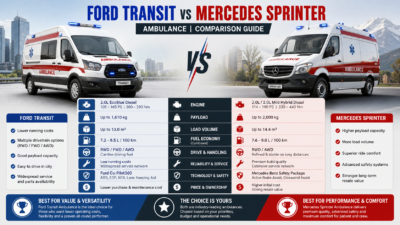
Ford Transit ambulances typically offer more powerful engine options (310 HP vs. 188 HP in the Sprinter diesel) and lower acquisition costs. Mercedes-Benz Sprinters provide excellent fuel economy and a premium driving experience but have higher purchase prices and potentially higher parts costs. Ford’s extensive dealer network offers service advantages in many regions. The choice often comes down to whether you prioritize power and service accessibility (Ford) or fuel economy and premium features (Mercedes) .
8. What safety features are standard on Ford Transit ambulances?
Ford Transit ambulances include Electronic Stability Control (ESC), Anti-lock Braking System (ABS), and Traction Control as standard equipment. Many upfitters add advanced safety technology including Lane-Keeping Aid, Blind-Spot Monitoring, and rear-view cameras. The patient compartment seating meets stringent SAE/NHTSA safety standards, and the overall design undergoes crash testing to protect occupants during emergency response driving .
9. Can a Ford Transit ambulance be used for critical care transport?
Yes, Ford Transit ambulances are increasingly popular for critical care transport. The Type III configuration offers the interior space needed for ventilators, multiple infusion pumps, and extensive monitoring equipment. The smooth ride quality of the Transit chassis is particularly beneficial for critically ill patients sensitive to motion. Specialty upfitters can create Mobile ICU configurations with enhanced electrical systems and medical gas capabilities .
10. What should I consider when choosing between new and remanufactured options?
New Ford Transit ambulances offer complete customization, full warranties, and the latest technology but require longer lead times and higher initial investment. Remanufactured units—where a new chassis is combined with a reconditioned patient module—provide significant cost savings and faster delivery while extending the life of well-maintained modules. This option is ideal for services with budget constraints or those looking to refresh their fleet more frequently .
Conclusion
The Ford Transit platform has fundamentally changed what EMS professionals can expect from their vehicles. With configurations ranging from agile Type II urban response vehicles to spacious Type III critical care units, there is a Ford Transit ambulance model suited to virtually any emergency service application.
By understanding the differences between available models, carefully evaluating your operational requirements, and working with experienced upfitters, you can select a vehicle that serves your community effectively for years to come. The combination of modern powertrain technology, thoughtful interior design, and robust construction makes Ford Transit ambulances a compelling choice for services at every level.
Whether you’re responding to 911 calls in a dense city, transferring critical patients between facilities, or providing community health outreach, the right Ford Transit ambulance becomes not just a vehicle, but a true partner in patient care.